Picture stepping into your backyard on a hot afternoon and being greeted not by patchy grass and a plastic kiddie pool, but by a pool that actually fits your lifestyle, budget, and space. The catch? Choosing the wrong type can leave you with constant repairs, surprise costs, and a design you grow tired of quickly.
Understanding the differences between in-ground and above-ground pools, concrete, fiberglass, and vinyl builds, plus newer and specialty designs, helps you balance upfront price with long-term maintenance, durability, and customization. It takes some planning and realistic budgeting, but that bit of homework now can mean years of easier upkeep and more enjoyable time in the water.
Choosing a swimming pool isn’t just about adding water to your backyard—it’s about deciding how you want to live, relax, and entertain every single day. Before you dive in, explore the different types of pools so your investment matches your lifestyle as much as your budget.
Reference: Best Type of Swimming Pool for Your Home
Understanding the Main Types of Pools for Homes
In-ground vs above-ground pools: big-picture overview
Residential pools generally fall into two structural categories: in-ground and above-ground. In-ground pools are built into an excavated hole and finished with concrete (gunite/shotcrete), fiberglass shells, or vinyl liners. Above-ground pools sit on the surface, often using steel, resin, or soft-sided frames like Intex and Bestway kits.
Homeowners often choose in-ground pools for long-term use, custom shapes, and a high-end look, similar to what you’d see in many Florida and California backyards. Above-ground options are common in suburbs across states like Ohio or Pennsylvania, where families want a seasonal pool with lower upfront cost, simpler installation, and less disruption to the yard.
Permanent vs semi-permanent vs temporary pool solutions
Pools are also defined by how long they’re intended to stay. Permanent pools include concrete and fiberglass in-ground installations that can last 25–50 years with proper care. Semi-permanent options might include high-quality steel-walled above-ground pools, which often last 10–15 years.
Temporary pools are typically soft-sided models from brands like Intex or Summer Waves that you can assemble in a weekend and drain each winter. A permanent gunite pool in Phoenix can become a key feature in an MLS listing, while a temporary 18-foot soft-sided pool is treated more like seasonal outdoor equipment than a fixed improvement.
How pool type affects cost, permits, and property value
Pool type has a direct impact on both budget and red tape. In-ground pools often range from $50,000–$120,000 in many US markets once you factor decking and landscaping, while above-ground kits can start under $3,000 at retailers like Lowe’s or Costco. Ongoing costs also differ: a larger in-ground pool typically uses more chemicals, water, and energy.
Most cities require full permits, inspections, and safety barriers for in-ground pools, and often for deeper above-ground pools as well. Real estate data from Redfin and Zillow analysis has shown in-ground pools can boost value in warm states by 5–7%, but in colder regions, value gains are smaller and more dependent on buyer preference.
Key questions to answer before talking to a pool builder
Before you call a builder like Suffolk Pool Corp, it helps to clarify why you want a pool. Think about whether your main goal is lap swimming, kids’ play, weekend parties, or quiet spa-style relaxation. A family in Dallas focused on kids’ use might prioritize a shallow play area, while a triathlete in San Diego might want a 40-foot lap lane.
Be honest about your budget range, timeline, and how long you expect to stay in the home—those choices often determine whether an in-ground or above-ground solution makes sense. Also walk your yard to note space, slope, access for excavation equipment, overhead power lines, and where gas, sewer, and septic lines run, since these can dramatically shape what’s possible and what it will cost.
In-Ground vs Above-Ground Pools: How to Choose What Fits Your Home
Structural differences: installation, depth, and lifespan
Structurally, in-ground and above-ground pools behave very differently once they’re filled with water. In-ground options usually require excavation, a compacted gravel base, and either a concrete, fiberglass, or vinyl-lined shell. Brands like Leisure Pools outline how fiberglass shells are craned into an excavated hole and then backfilled, which adds stability and can resist shifting soils better than basic steel-wall above-ground kits.
Depth is another major separator. In-ground pools commonly offer 6–8 ft deep ends suitable for diving (when built to code), while most above-ground models from retailers like Doughboy or Intex top out around 52 inches of wall height. That shallow profile limits diving and cannonball fun, but makes above-ground pools friendlier for young swimmers.
In terms of lifespan, a well-built concrete, steel wall or fiberglass in-ground pool can last 25–40 years with resurfacing, whereas many above-ground pools have a practical life of 10–15 years before wall rust or liner wear forces replacement.
Concrete (Gunite/Shotcrete) Pools: Customizable & Long-Lasting
Concrete (Gunite/Shotcrete) Pools: Customizable & Long-Lasting
What a concrete pool is and how a pool builder constructs it
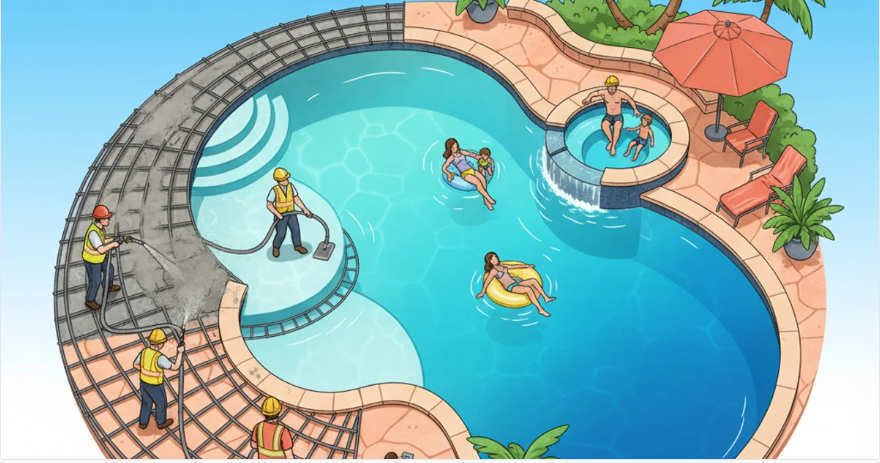
Concrete pools use a reinforced shell made from either gunite (dry-mix) or shotcrete (wet-mix) sprayed over a steel rebar cage. Both methods create a dense, structural concrete shell that’s then finished with plaster, pebble, or tile.
A typical build in cities like Dallas or Phoenix starts with layout and excavation, followed by installing steel rebar and plumbing. Crews then spray gunite or shotcrete, shape the shell, and allow it to cure for about 28 days before finishing and filling. On-site work often spans 8–12 weeks for a standard 16' x 32' pool.
Design flexibility: shapes, depths, tanning ledges, and custom features
Because concrete is shaped on site, it supports freeform layouts, deep ends, and complicated transitions. Builders can create a 3' shallow lounging zone that slopes to an 8' diving area or wrap a pool around an existing patio.
Features like 6–8 inch deep tanning ledges, beach entries, raised spas, benches, and custom steps are easy to integrate. Many homeowners add LED niche lights, deck jets, or a sheer-descend waterfall to match high-end resorts in Las Vegas or Miami.
Durability, maintenance needs, and resurfacing considerations
With proper engineering and drainage, a concrete shell can last 40–50 years or more. Surface finishes vary: white plaster is budget-friendly but often needs resurfacing every 8–12 years, while exposed aggregate pebble finishes can last 15–20 years with good water chemistry.
Signs it’s time to resurface include rough texture, visible gunite, persistent staining, or frequent algae even with proper chemistry. In many US markets, resurfacing a 400–500 sq. ft. pool with pebble can range from $7,000–$12,000 depending on tile and prep work.
Ideal homeowners: when concrete is worth the higher price and timeline
Concrete shines for homeowners who want fully custom design and long-term value over the lowest upfront cost. It’s often chosen on sloped or irregular lots where a fiberglass shell simply won’t fit or meet design goals.
If you can accommodate a 3–4 month build and a higher initial budget, concrete delivers premium aesthetics, structural longevity, and the freedom to add future features like a spa or new water features without replacing the whole pool.
Reference: Gunite & Shotcrete Pools: Strength Meets Style
Fiberglass Pools: Faster Installation with Lower Maintenance
How fiberglass pools are made and installed in your yard
Fiberglass pools start life as one-piece shells built in a controlled factory mold. Brands like Leisure Pools and Thursday Pools ship these finished shells by flatbed truck, so the size of the load and access to your yard matter a lot for planning.
Once on site, a crew excavates the hole, sets a gravel base, cranes the shell into place, then backfills around it while filling the pool with water. Plumbing and equipment are connected, and in many projects the pool is swimmable in about a week. According to The Fiberglass Advantage, fiberglass installs can be operational in days, compared with several weeks or even months for a concrete pool.
Standard shapes and sizes: what you can and can’t customize
Because fiberglass pools are pre-manufactured, you choose from a catalog of models and dimensions rather than designing a shell from scratch. For example, Leisure Pools’ “Elegance 30” is 30' x 14', while their “Fiji Plunge” is just 10' x 7' for compact lots.
You can usually customize gelcoat color, steps, tanning ledges, and features like bench seating or built-in spa sections. What you give up is the freedom to create unique free-form shapes, extra-deep diving wells over about 8', or complex multi-level designs that are easier to achieve with concrete.
Pros and cons vs concrete and vinyl liner pools
The smooth, nonporous fiberglass surface resists algae, reducing chemical demand and brushing. That’s a major reason fiberglass pools provide the lowest maintenance compared to concrete or vinyl. Owners often report saving several hours per month on cleaning alone.
Fiberglass shells are highly durable and don’t require resurfacing every 10–15 years like many plaster pools, and there’s no liner to puncture. The main trade-offs are transport limits (usually under about 16' wide), crane access for the large shell, and fewer options for very large or resort-style custom shapes that concrete can handle more easily.
When a fiberglass pool is a smart choice for your property
Fiberglass shines when you want a predictable, low-stress project. If you’re hoping to install in spring and be swimming by Memorial Day, the faster install window gives you a big advantage over concrete timelines.
It’s especially attractive for families who want a comfortable, non-abrasive surface that’s gentle on kids’ feet and easier on sensitive skin. If your property has straightforward truck and crane access and enough room to maneuver a one-piece shell into place, a fiberglass model can deliver a clean, modern look with far less ongoing maintenance than most concrete or vinyl builds.
Reference: Are Fiberglass Pools Easier to Maintain?
Vinyl Liner Pools: Budget-Friendly Custom Shapes
Vinyl Liner Pools: Budget-Friendly Custom Shapes
Anatomy of a vinyl liner pool: structure, walls, and liner
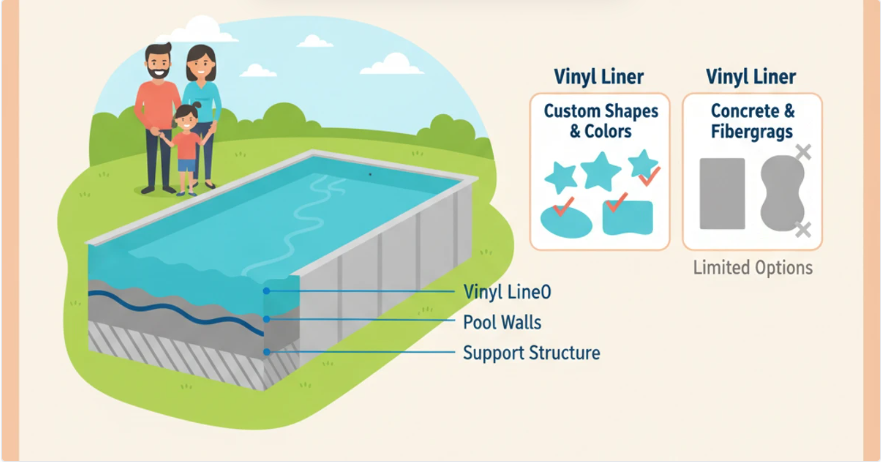
Vinyl liner pools use a modular shell to keep costs down while still allowing custom layouts. The walls are typically made from galvanized steel panels, corrosion-resistant polymer panels, or poured concrete, all anchored to a concrete footing and backfilled for stability.
Inside that frame, a custom-measured vinyl liner is snapped into a track along the coping to create a smooth, waterproof surface. Installers like Suffolk Pool Corps often add molded fiberglass or vinyl-covered steps and benches, so you can have tanning ledges or corner seats without paying for a full concrete build.
Cost profile: initial savings vs long-term liner replacement
Vinyl liner pools usually start around $40,000–$65,000 in many U.S. markets, often $20,000–$40,000 less upfront than comparable gunite/concrete or premium fiberglass shells. That lower entry cost appeals to homeowners who want a full-sized 16' x 32' or 18' x 36' pool without stretching into six figures.
The trade-off is liner replacement. Most quality liners last 8–12 years with proper chemistry and use, and replacement typically runs $4,000–$8,000 depending on size and features. Savvy buyers plan ahead by setting aside $40–$70 per month in a sinking fund so the future liner swap feels like routine maintenance instead of a surprise expense.
Design options and limitations compared to concrete and fiberglass
Because walls are panel-based, vinyl pools can be shaped into classic rectangles, freeforms, or lazy-L designs at moderate cost. A 20' x 40' rectangle with a shallow sun shelf and bench seating is often thousands less than a similar concrete pool, while still allowing deep ends up to about 8 feet.
Liners come in multiple thicknesses, commonly 20–27 mil, with patterns that mimic tile, pebble, or marble. Brands like Loop-Loc and Merlin offer textured steps for better grip. Still, vinyl doesn’t love razor-sharp inside corners, extreme depths beyond diving standards, or heavy commercial-style use, where concrete or fiberglass tends to hold up better.
Best-fit scenarios for choosing a vinyl liner in-ground pool
Vinyl works well for families who want a customizable in-ground pool without the higher concrete price tag. For example, a Springfield, Missouri homeowner might choose a 16' x 32' vinyl pool with a built-in bench and simple heater, keeping the project near $55,000 instead of $80,000+ for a similar gunite design.
It’s also a strong choice in regions like the Midwest and Southeast where vinyl pools are common and service pros are easy to find. Homeowners willing to budget for liner replacements and who prioritize comfort underfoot and design flexibility often find vinyl to be the best balance of cost, customization, and long-term enjoyment.
Reference: Inground Vinyl Liner Pools
Above-Ground Pools: Flexible, Affordable Backyard Fun
Common above-ground pool types (steel, resin, hybrid, soft-sided)
Above-ground pools come in several construction styles, each balancing price, durability, and looks. Steel-walled pools, like the popular Embassy and Sharkline models sold through retailers such as Leslie’s Pool Supplies, use galvanized steel walls and uprights for strength and long life.
Resin pools swap metal for high-density resin components, which resist rust and corrosion in humid climates or near saltwater systems. Hybrid pools combine steel walls with resin top rails and posts, offering the rigidity of metal and the low-maintenance benefits of resin.
Soft-sided options, including Intex and Bestway frame and inflatable pools, are designed as seasonal or starter pools. They’re far less expensive—often $400–$1,200 for a 16–20 ft round—yet won’t match the 15–20 year lifespan of a quality steel or resin model, which can run $3,000–$8,000 installed.
Installation basics: site prep, permits, and safety considerations
Before installing an above-ground pool, the most important step is preparing a level, stable base. Many pros use a laser level to create a flat pad of compacted crushed stone topped with sand or foam panels, which helps protect the liner and prevent wall stress.
Most US cities, including places like Long Island and Charlotte, require permits for pools deeper than 24 inches. Local codes may call for electrical inspections and a barrier at least 4 feet high with self-closing, self-latching gates, even for above-ground setups.
Safety gear is not optional. A secure ladder that can be locked or removed, a code-compliant fence, and a barrier system like a Safety Fence brand removable fence significantly reduce accident risk, especially for homes with young children or nearby neighbors.
Upgrades that make above-ground pools feel more permanent
Thoughtful add-ons can make an above-ground pool look integrated with your yard rather than temporary. Wrap-around wood or composite decks, like those built with Trex or TimberTech boards, create lounging space and a clean transition from house to pool.
Landscaping with river rock, low-maintenance shrubs, and privacy screens such as lattice panels or vinyl fencing helps hide the pool walls and equipment. Many homeowners also add low-voltage LED lighting around the deck to extend evening use.
Upgraded filtration systems, like a larger Hayward sand or cartridge filter, paired with a heat pump or gas heater, deliver more consistent water quality and a longer swimming season. Skirting around the base and integrated steps or resin entry systems improve both aesthetics and everyday usability.
When to treat an above-ground pool as a “starter” vs long-term solution
An above-ground pool is often a low-risk way to see how much your family actually swims. A $900–$1,500 soft-sided Intex Ultra XTR frame pool can handle several seasons and help you track usage before committing to a $60,000+ in-ground build.
If your family uses the pool heavily and you plan to stay in the home 7–10 years, it can make sense to invest in a higher-end resin or hybrid model with a robust pump, quality liner, and deck. Many pool owners treat this as a semi-permanent solution instead of going in-ground.
Homeowners with long-term plans to install an in-ground pool sometimes design their above-ground location, decking, and electrical runs so they can later convert the space. Working with a pool builder early can help ensure today’s above-ground setup doesn’t conflict with tomorrow’s excavation and utility layout.
Reference: Above Ground Pools
Specialty Pool Types: Lap, Plunge, Infinity, and More
Specialty Pool Types: Lap, Plunge, Infinity, and More
Lap pools for fitness-focused homeowners and narrow yards
Lap pools are purpose-built for swimming workouts rather than lounging. They’re typically long and narrow—often 40–75 feet in length and about 8–12 feet wide—using a simple rectangular layout that makes it easy to track distance and maintain a consistent stroke.
For dedicated swimmers, a lap pool turns the backyard into a personal training lane. A homeowner in Austin, for example, installed a 45-foot lap pool with a swim pace clock to replicate their local YMCA setup, allowing daily interval workouts without commuting. Because lap pools can run along property lines, they’re ideal for side yards that are too tight for a standard 16×32-foot family pool.
Plunge pools and cocktail pools for small spaces and low maintenance
Plunge and cocktail pools are compact, social, and easy to care for. A plunge pool is usually 8–12 feet wide and 10–16 feet long, with deeper water—often 4–6 feet—for full-body soaking. Cocktail pools are similar or slightly larger, but geared toward entertaining with benches and shallow lounging areas.
Because these pools hold less water than a full-size design, chemical costs and cleaning time drop significantly. A 10×16 plunge pool in Tampa, for instance, may use less than half the water of a standard pool, lowering energy use for pumps and heaters. Many owners add a gas or electric heater so the pool doubles as a warm soaking spot in cooler months, much like a large spa that’s usable nearly year-round.
Infinity and vanishing-edge pools for premium views and design impact
Infinity and vanishing-edge pools create the illusion that water spills seamlessly into the horizon. One or more edges are lowered so water flows over into a hidden catch basin, then recirculates. This visual effect is especially striking when the pool overlooks a lake, city skyline, or wooded valley.
These designs work best on sloped lots or elevated sites where the eye can follow the waterline into a distant view. A hillside home above Lake Travis, for example, might use a vanishing edge aimed directly at the water to erase the boundary between pool and lake. Because of complex structural engineering, extra steel and concrete, and added pumps and surge tanks, infinity pools generally cost more per square foot than standard perimeter-overflow designs.
Indoor, semi-indoor, and enclosed pools for year-round swimming
Indoor and enclosed pools extend swim season well beyond summer. A fully indoor pool sits entirely within the home’s building envelope, while semi-indoor designs may project from the house under a large roof or glass structure. Screened or glass-enclosed pools, common in Florida, surround an outdoor pool with framing and panels for weather and bug protection.
These setups demand careful climate control and ventilation. Dedicated dehumidification systems, like those used in commercial facilities such as YMCA indoor pools, help manage condensation and protect building materials. For homeowners in colder regions like Minnesota, a properly insulated indoor or attached-pool room can provide comfortable swimming 12 months a year, regardless of snow, wind, or pollen outside.
Reference: 12 Swimming Pool Types to Consider
Choosing the Right Pool for Your Budget, Yard, and Lifestyle
Matching pool type to how you’ll actually use it (kids, fitness, entertaining)
How you spend Saturdays around the pool should drive every design decision. A family that hosts big barbecues a few times a month will need something very different from a homeowner who wants quiet lap sessions before work.
If playtime is the priority, a shallow lounging area and a max depth around 5 feet often works best. Families in suburbs like Frisco, Texas frequently choose 32' x 16' freeform pools with tanning ledges, because kids can splash while adults relax on in-pool loungers.
For fitness, a 40' rectangular pool with swim lanes or a swim-current system (like Endless Pools) makes daily laps realistic. Entertainers might add a 10'–15' baja shelf, built-in benches, and a spa so guests can spread out during parties.
Safety should guide depth transitions, step placement, and fencing. Households with toddlers or older adults often install self-closing gates and raised walls on one side to block unsupervised access, following guidelines similar to those from the U.S. Consumer Product Safety Commission.
Assessing your yard: soil, slope, easements, and access for a pool builder
Your yard’s conditions can add thousands of dollars to a project if you don’t plan ahead. Pool builders start by looking at soil type, drainage, and how water moves across your property during heavy rain.
Clay-heavy soils common in parts of Georgia may require over-excavation and added steel to prevent shifting, while sandy soils in Florida sometimes need stabilization so walls don’t cave during the dig. Poor drainage can mean adding French drains or deck drains to keep water from flooding your patio and pool equipment.
Slopes often lead to retaining walls or raised beam designs. A 3–4 foot grade change might require a $10,000–$20,000 wall and extra engineering. Easements and setbacks—like a 10-foot utility easement or 5-foot side setback—can shrink the buildable area more than you expect.
Access is another big cost driver. If the builder can’t get a standard excavator into your yard and has to use mini skid-steers through a side gate, excavation time and cost can jump by several thousand dollars.
Total cost of ownership: energy, chemicals, repairs, and upgrades
The purchase price is only part of the story. A typical in-ground pool in the U.S. might cost $60,000 to install but $2,000–$4,000 per year to operate, depending on climate and equipment choices.
Energy is a major expense. Variable-speed pumps from brands like Pentair or Hayward can cut electricity use by up to 70% compared with single-speed models, which can translate into hundreds of dollars saved annually. Gas heaters warm water quickly, but burn more fuel, while heat pumps cost more up front yet often pay off in regions with mild winters.
Chemicals, filter media, and routine service add up. Many homeowners in Sunbelt states spend $80–$150 per month on professional maintenance. Over 10–15 years, expect to replace pumps, heaters, and possibly resurfacing on plaster pools—often in the $7,000–$15,000 range.
Building a small reserve fund—say $500–$1,000 per year—helps absorb future upgrades like automation systems, LED lighting, or a switch to saltwater chlorination without financial stress.
How to compare quotes from different pool builders and avoid hidden costs
Two quotes that look similar at first glance can differ by tens of thousands of dollars once you unpack the details. The key is to insist on itemized proposals that show line-by-line pricing and clear specifications.
Ask each builder to break out excavation, steel, gunite or fiberglass shell, tile, plaster, equipment models, and startup chemicals. Then look for items that are often left out of base pricing: electrical runs to the panel, gas lines for heaters, code-required fencing, extra decking, and haul-off fees for dirt.
Clarify what’s covered under warranties for structure, equipment, and workmanship, and how long each lasts. Some builders offer lifetime structural warranties but only 1–3 years on equipment.
Finally, request written policies on allowances and change orders. If the quote includes a $5,000 allowance for tile and coping but your selections total $7,000, you should know exactly how that $2,000 overage will be billed before you sign anything.
Reference: Choosing The Right Swimming Pool For Your Lifestyle
Working with a Pool Builder: From Concept to Completion
What to bring to your first meeting with a pool builder
Your first meeting sets the tone for the entire project, so come prepared. Start with a rough budget range, such as $70,000–$120,000 for a custom gunite pool in cities like Dallas or Tampa, and a list of must-have features like a tanning ledge, spa, or heater. Many homeowners bring a small folder of inspiration images from Pinterest or Houzz to show styles they like.
It also helps to gather site documents. A property survey, notes on underground utilities (often from 811 locate services), and any HOA rules or city setbacks can prevent design revisions later. Bring a written list that separates must-haves (safety fence, auto cover) from nice-to-haves (waterfalls, deck jets) so builders like Suffolk Pool Corp can tailor options to your priorities.
Key questions to ask about timelines, permits, and warranties
Before signing, clarify how long the project will realistically take. Ask, “What is your typical duration for a 400–500 sq. ft. concrete pool, and what usually causes delays?” In many US markets, a standard build runs 8–12 weeks, but weather, inspections, and material shortages can add time. Get their answers in writing in your proposal or contract.
Confirm whether the builder handles permits, engineering, and inspections with the city or county. Reputable contractors will submit plans to local building departments and coordinate all inspections. Then review warranties line by line: structure (often 10+ years or lifetime), equipment (typically 3–5 years from brands like Pentair or Hayward), and workmanship (commonly 1–3 years). Ask who performs warranty service and how to submit a claim.
Understanding the construction phases for different types of pools
Pool construction follows similar phases, but timelines differ by pool type. For a concrete (gunite or shotcrete) pool, expect design and permitting, excavation, steel rebar, plumbing, gunite shell, tile and coping, decking, interior finish, then startup. This often runs 10–14 weeks, whereas a fiberglass shell from manufacturers like Latham can be set and plumbed in 3–6 weeks once permits are ready.
Vinyl-liner and above-ground pools are usually quicker, but still involve site prep, leveling, and electrical work. During excavation and gunite, anticipate loud compressors, dust, and limited driveway access for trucks. Many homeowners in suburban neighborhoods plan around school schedules or work-from-home days because of noise, and discuss fence panels or temporary gates so crews can access the yard without damaging landscaping.
Red flags that a pool builder may not be the right fit
Not every contractor is a good match. Be cautious if the builder refuses to provide proof of liability insurance or workers’ comp, or won’t share recent local references you can call. Vague one-page contracts with no detailed specs, payment schedule, or change-order process are another warning sign. Compare their quote to at least two others; if one bid is 20–30% below the market average in your area, ask what corners are being cut.
Pay attention to communication style. High-pressure tactics like “this price is only good if you sign today” or dodging specific questions about equipment brands, steel thickness, or timeline responsibilities are serious concerns. Many complaints filed with state contractor boards and the Better Business Bureau start with homeowners ignoring early signs of poor communication or constant schedule excuses during the sales process.
Reference: The Ultimate Guide to Designing Your Dream Pool
Conclusion: Making a Confident Decision About Your Home Pool
Key takeaways: in-ground vs above-ground pools and main pool types
When you compare in-ground and above-ground pools, it often comes down to cost and permanence. A basic above-ground pool kit from brands like Intex or Bestway can start under $3,000 installed, while many in-ground projects from builders such as Premier Pools & Spas start closer to $55,000–$70,000 in many US markets.
Concrete pools offer full customization and long life but need resurfacing every 10–15 years. Fiberglass shells install quickly and are low-maintenance, while vinyl liner pools have a lower upfront price but require liner replacements. Above-ground options are the easiest to remove or upgrade later, making them ideal if you might relocate in 5–10 years.
How to align pool choice with budget, property, and long-term plans
The best pool is the one that fits your finances and lifestyle over 10–20 years, not just this summer. A family in Phoenix might justify a $70,000 in-ground pool they’ll use eight months a year, while a New Jersey homeowner could be better off with a $15,000 above-ground or modest vinyl in-ground for a shorter season.
Think about lot size, sun exposure, and resale. In many Sunbelt neighborhoods, well-designed in-ground pools can add 5–7% to property value, according to some real estate agents, while an oversized or poorly placed pool can actually limit buyer interest.
The value of planning with a reputable, transparent pool builder
A seasoned builder can flag issues you may never consider, like how a high water table or clay soil will affect your structure and drainage. Companies that share detailed itemized estimates and 3D renderings, such as those using Pool Studio design software, help you see costs and layout before any digging begins.
Look for contractors with strong local reviews, clear contracts, and proof of insurance. A good builder will walk you through permits, fencing, and barrier rules based on your city or county, reducing the risk of failed inspections or mid-project changes.
Next steps: research, site evaluation, and design consultation
Start by collecting ideas: save photos from Pinterest, manufacturer galleries like Latham Pools, and recent installs in your neighborhood. Create a shortlist of must-haves—perhaps a 12' x 24' lap lane, a Baja shelf, or a safety cover—then pair that with a realistic budget range.
From there, schedule on-site visits with two or three local builders. Use those consultations to compare concepts and timelines, ask about warranties, and decide whether an in-ground, fiberglass, or above-ground setup gives you the best mix of enjoyment, cost, and long-term flexibility.
FAQs About Types of Pools and Working with a Pool Builder
How do I know which type of pool is best for my climate and soil conditions?
Climate and soil can quietly determine whether your pool is low-maintenance or a constant headache. Areas with heavy clay, like parts of Dallas–Fort Worth, often deal with expanding soils, while regions such as Minnesota face intense freeze–thaw cycles that stress pool structures.
A reputable local builder or geotechnical engineer can recommend whether a reinforced concrete pool, a fiberglass shell with proper drainage, or a steel-walled vinyl pool is more appropriate. For example, many builders near the Florida coast design pools with French drains and sump systems to manage high water tables.
Why do in-ground pools vary so much in price between pool builders?
Two quotes that look similar on paper can differ by $20,000 or more because of what’s actually included. Higher-end builders may use Pentair or Hayward variable-speed pumps, thicker steel rebar, and premium PebbleTec finishes, while budget bids might specify basic white plaster and single-speed pumps.
Carefully compare line items: some contractors exclude decking, electrical runs, or safety fencing from the base price. Also weigh warranty and service—companies that offer 5–10 year workmanship warranties and in-house service teams usually factor that support into their pricing.